Golf Club Distances: The Complete Guide for Every Golfer
- Next Shot Golf
- Aug 17, 2025
- 3 min read

Updated: 4 days ago
One of the fastest ways to lower your scores is knowing exactly how far you hit each club. Yet, many golfers guess their distances—often leading to missed greens, poor layups, and avoidable bogeys.
This guide breaks down average golf club distances for different skill levels, explains what affects yardages, and gives you a step-by-step plan to find your numbers.
Average Golf Club Distances by Skill Level
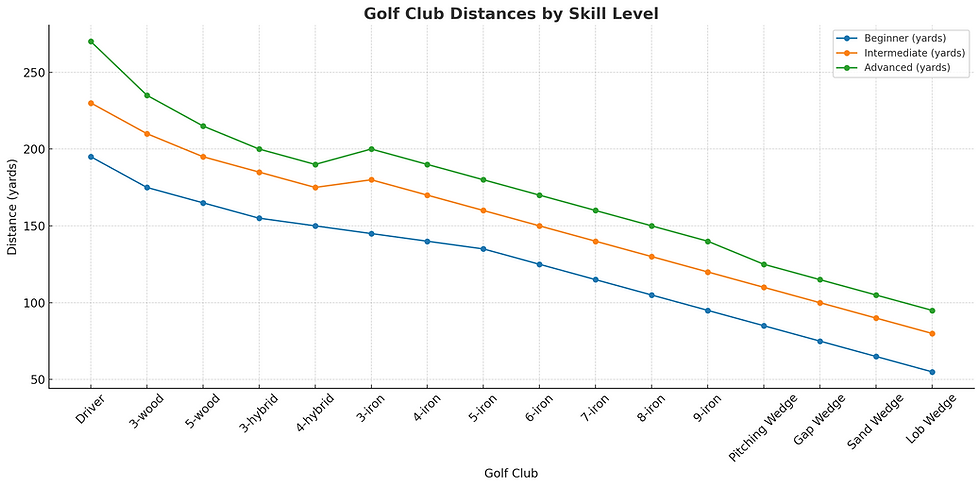
The chart below shows average carry distances for men’s clubs, based on beginner, intermediate, and advanced players.
Club | Beginner (yards) | Intermediate (yards) | Advanced (yards) |
Driver | 180–210 | 215–240 | 250–300+ |
3-wood | 160–190 | 200–220 | 215–240 |
5-wood | 150–180 | 185–205 | 200–220 |
3-hybrid | 140–170 | 175–190 | 190–210 |
4-hybrid | 135–165 | 170–185 | 185–200 |
3-iron | 130–160 | 165–180 | 180–200 |
4-iron | 125–155 | 160–175 | 170–190 |
5-iron | 120–150 | 150–170 | 160–180 |
6-iron | 110–140 | 140–160 | 150–170 |
7-iron | 100–130 | 130–150 | 140–160 |
8-iron | 90–120 | 120–140 | 130–150 |
9-iron | 80–110 | 110–130 | 120–140 |
Pitching Wedge | 70–100 | 100–120 | 110–130 |
Gap Wedge | 60–90 | 90–110 | 100–120 |
Sand Wedge | 50–80 | 80–100 | 90–110 |
Lob Wedge | 40–70 | 60–90 | 70–100 |
💡 Note: These are averages. Your personal distances will vary based on swing speed, strike quality, loft, and ball type.
🎯 Want to Know YOUR Exact Distances?
Charts are helpful — but your real advantage comes from knowing your own numbers.
👉 Download the Free Next Shot Golf Performance Tracker and start tracking your carry distances so you can build your own personalized distance chart.
✔ Track every club in your bag✔ Identify your distance gaps✔ Improve your club selection
Factors That Affect Golf Club Distances
1. Swing Speed
The faster you swing, the more ball speed you generate. This is the biggest factor in distance differences between beginners and advanced players.
2. Loft & Club Design
Modern clubs—especially drivers, hybrids, and game-improvement irons—are designed to launch higher with less spin, adding distance.
3. Ball Choice
Low-compression balls can help slower swing speeds gain distance, while high-compression tour balls benefit faster swings.
4. Weather & Altitude
Cold air, wind, and sea level reduce distance; warm air and high altitude add it.
5. Strike Quality
A centered strike matters more than raw speed. Off-center hits can cost 10–20 yards or more.
How to Find Your Golf Club Distances
Step 1: Use a Launch Monitor
A personal launch monitor like the Garmin R10 or Rapsodo MLM2Pro session at your local range will give you carry distances for each club.
Step 2: Focus on Carry Distance, Not Total Distance
Rollout can change based on course conditions. Carry distance is consistent and reliable for club selection.
Step 3: Record and Chart Your Numbers
Create a personal golf club distances chart for your bag and keep it in your yardage book or phone.
Step 4: Update Regularly
Recheck your numbers every few months, especially if you’ve changed clubs, balls, or made swing improvements.
How to Gap Your Clubs for Optimal Distance Coverage
One of the most overlooked parts of scoring better is distance gapping—making sure you don’t have big yardage holes in your set.
What is Gapping?
Gapping is the process of ensuring the distance difference between each club in your bag is consistent—usually 10–15 yards apart for most amateurs.
Without proper gapping, you might have two clubs that go almost the same distance or a 20–30 yard gap that forces you into awkward in-between shots.
How to Check Your Gapping
Get Your Carry Distances: Use a launch monitor or simulator to measure the carry for each club.
Write Them Down: Put your numbers in a chart or on a yardage card.
Look for Overlaps: If your 6-iron and 5-iron are only 5 yards apart, you might not need both—or you might need a different loft setup.
Fill the Gaps: Consider adding a hybrid, extra wedge, or adjusting lofts to close large gaps.
Example Gapping for an Amateur Golfer
Club | Carry Distance | Gap from Previous |
Driver | 230 yds | — |
3-wood | 210 yds | 20 yds |
4-hybrid | 190 yds | 20 yds |
5-iron | 170 yds | 20 yds |
6-iron | 160 yds | 10 yds |
7-iron | 150 yds | 10 yds |
8-iron | 140 yds | 10 yds |
9-iron | 130 yds | 10 yds |
PW | 115 yds | 15 yds |
GW | 100 yds | 15 yds |
SW | 85 yds | 15 yds |
LW | 70 yds | 15 yds |
Pro Tip:
If you’re a slower swing speed player, aim for smaller gaps (8–12 yards).
Faster swingers can maintain 12–15 yard gaps for optimal versatility.
Why Knowing Your Distances Lowers Scores
When you know your numbers:
You avoid coming up short on approaches
You can lay up to exact wedge yardages
You choose the right club under pressure
You make smarter course management decisions
Final Thoughts
Guessing distances is like guessing yardage to the pin—you might get lucky, but you won’t be consistent. Spend a couple of range sessions mapping out your real numbers and watch your scores drop.


